3 reasons commercial buildings underperform (and how to fix them)
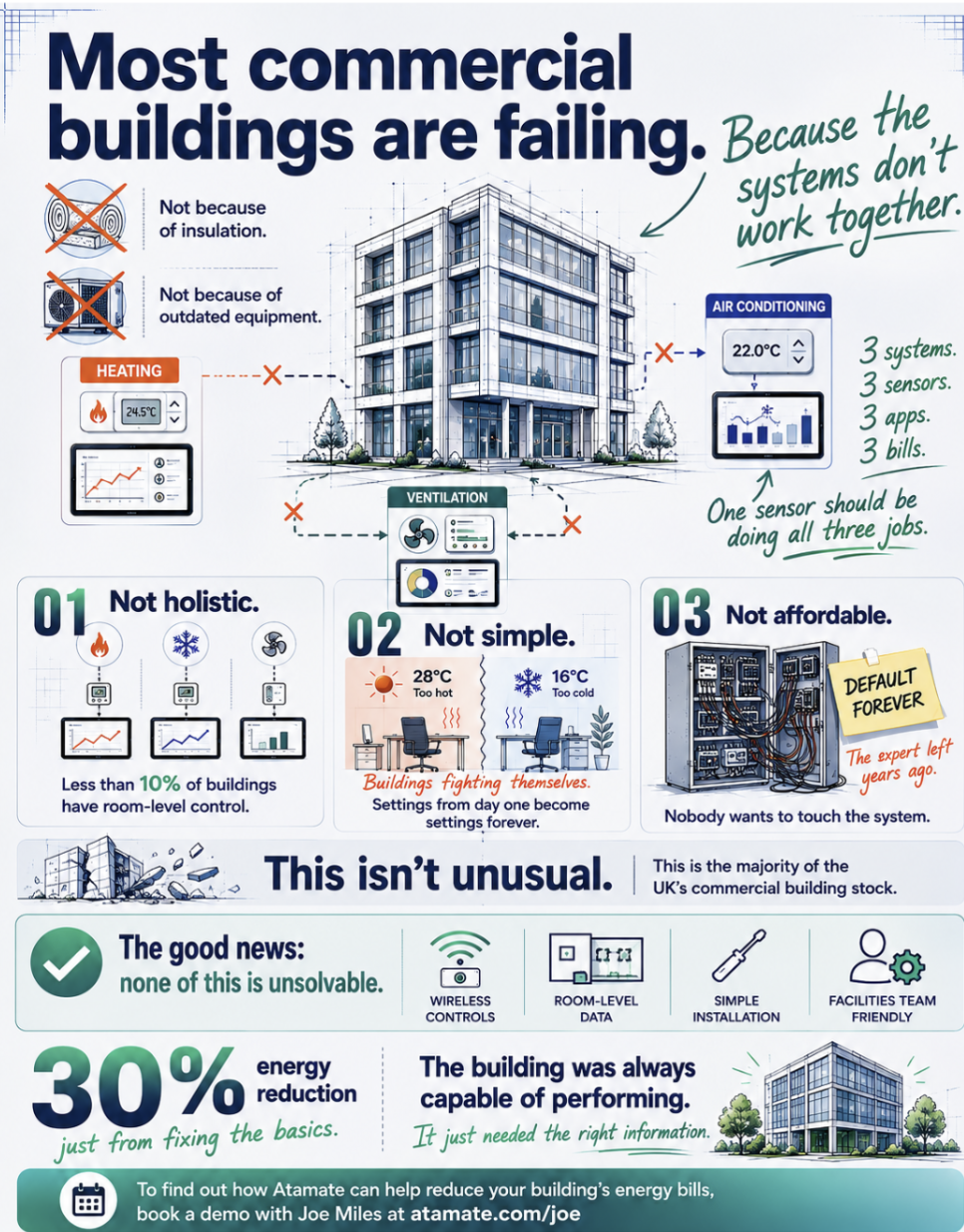
Most commercial buildings are failing. Not because of bad insulation. Not because of outdated equipment.
Because nobody fixed the 3 things that actually matter.
I've been building and developing low-energy buildings for 30 years. The same problems kept showing up on every site.
So I broke it down.
3 reasons buildings underperform:
1/ They're not holistic. Less than 10% of buildings have room level control. Where they do heating has one system, air condition another, and there are no ventilation interlocks; nobody shares data. One sensor should be doing all three jobs. Instead, you've got 3 sensors, 3 apps, and 3 bills. The "single pane of glass" everyone talks about needing? Most buildings will never see it with how they're currently set up.
2/ They're not simple. Buildings are handed over half-commissioned. Nobody comes back in spring. Nobody comes back in summer. The settings from day one are the settings forever. Meanwhile the building is fighting itself, the south-facing rooms are roasting and the north-facing rooms have portable electric heaters stuffed under every desk.
3/ They're not affordable. Traditional BMS systems require bespoke programming for every room, every fan coil unit, every circuit. You end up with a system so complicated that the only person who understands it left the company three years ago. So nobody touches it. And it runs on default settings, wasting energy, year after year.
These aren't edge cases. This is the majority of the UK's non-domestic building stock.
The good news: none of this is unsolvable.
Wireless controls. Room-level data. Systems any electrician can install and any facilities manager can actually use.
We're seeing 30% energy reductions just from fixing the basics.
The building was always capable of performing. It just needed the right information.
For practical insights on making buildings perform as they should book a call: