Student Accommodation Energy Management, Room by Room
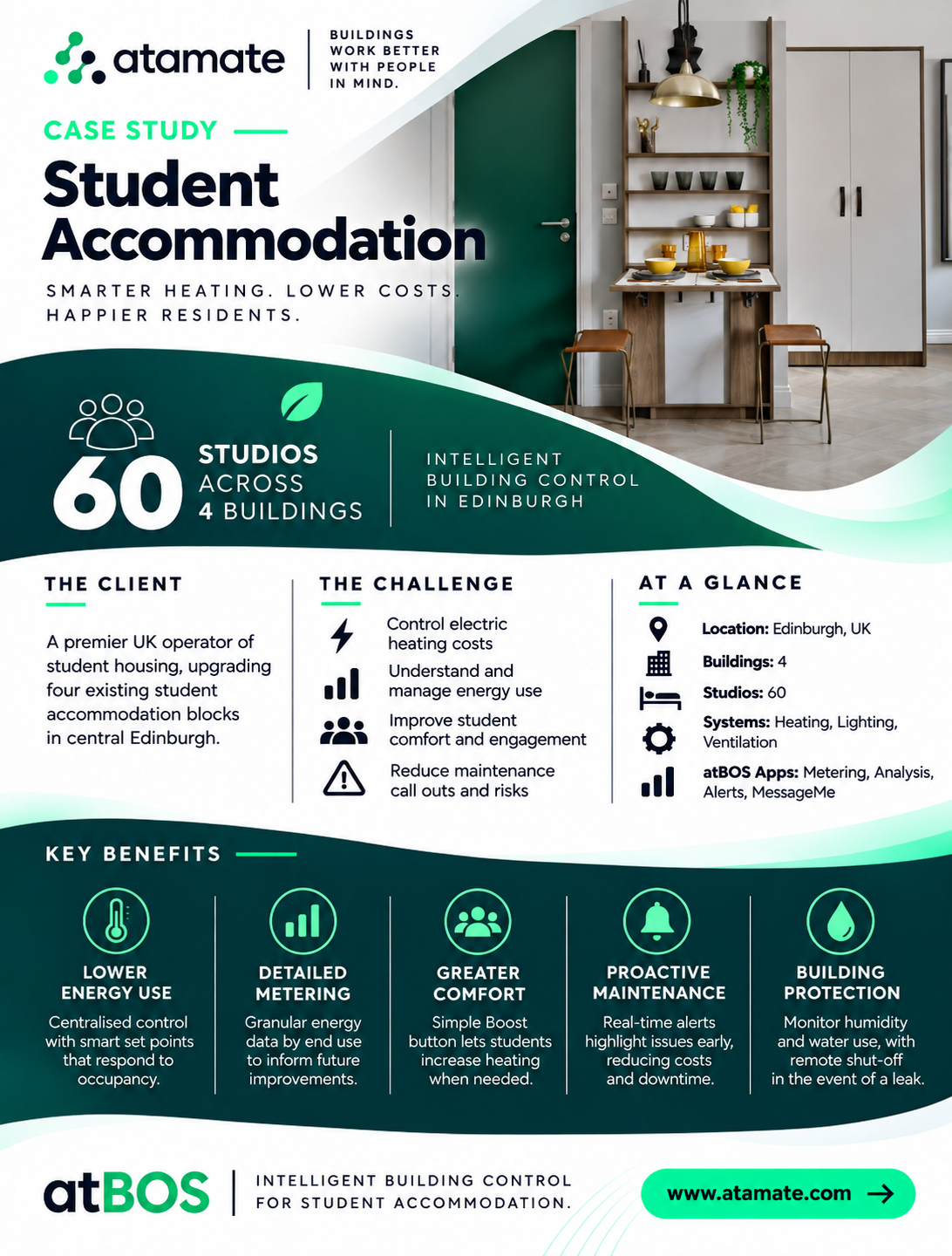
Sixty studios. Sixty different sets of habits.
Four tenement buildings in central Edinburgh. All heated by electricity.
How do you keep every student comfortable, keep energy use in check and spot problems early, without sending someone round every room?
That was the brief from our client. Here's how atBOS delivers student accommodation energy management at room level.
The challenge: all-electric heating with no visibility
Our client was a leading provider and operator of prime city-centre student accommodation in university towns and cities across the UK.
This project upgraded four of its existing blocks in central Edinburgh: classic tenement buildings, with 60 studios over levels 2 to 4 and shops below.
Everything runs on electricity. Panel heaters, point-of-use water heaters, electric showers, central extract for the ensuites and a kitchen extract fan in each studio.
All-electric heating can be expensive. Unless it's properly controlled.
They wanted four things:
Efficiency and comfort. Central control of set points, plus a simple way for students to warm their room.
Metering. Energy broken down by end use, to inform future developments, share with occupants and flag unusual patterns.
Fewer maintenance call-outs. Alerts that let the team act early and plan maintenance.
Protection of the building fabric. No humidity build-up leading to mould. Leaks spotted early, with remote water shut-off.
That's a lot to ask of existing buildings. But atBOS is wireless and retrofittable. It works on the buildings you already have.
The Atamate solution: three units in every studio
Atamate installed three components in each studio.
Sensor Unit. Monitors temperature, carbon dioxide (CO2), relative humidity, volatile organic compounds (VOCs), ambient light and occupancy. Its two relays provide a master override for the lighting and a water shut-off valve.
Relay Unit. Controls the room heater and the kitchen extract fan. It also connects to a Boost button and to a sensor that checks air is actually flowing from the kitchen fan.
Metering Unit. Fitted in each studio's consumer unit, it monitors 8 circuits: the main incoming supply plus 7 sub-circuits, including space heating, hot water, lighting, cooking and sockets.
Every reading goes to the cloud, where our client's teams can see it live or look back over time in the Atamate Analysis app.
How student accommodation energy management works at room level
Two set points, not one
Each studio has three set points. One for when it's occupied. One for when it's empty. A boost button that is customisable but typically increases the temperature for an hour by 3C or until the occupant leaves the room.
When a student goes out, the temperature sets back. When they come home, the fast-responding panel heater brings the room back up quickly.
You wouldn't keep the lights on in an empty room. Heating should work the same way.
A Boost button, managed centrally
Press the Boost button and the set point lifts for a while. The building manager decides how far and for how long.
Over time, our client will use the data to bring set points down as far as possible without students reaching for the Boost button all day. Lower energy use. The right level of comfort.
Energy broken down by end use
Because every circuit is metered, our client can see total electricity use across the site and consumption by end use for each studio, daily, weekly or monthly, and set against occupancy.
You can't reduce what you can't see. Now our client can see it.
Fewer call-outs: alert monitoring that spots problems early
Data is only useful if someone acts on it. So the Atamate Alert Monitoring app analyses the data continuously and flags potential faults:
→ Unusual increases in energy use
→ Excessive water consumption that points to a leak
→ A heater that's switched on but draws no power or doesn't change the temperature
→ A fan that's switched on but produces no change in pressure
It also picks up alerts from central plant such as fans and water boosters. Alerts are graded by severity, and the MessageMe app sends them to named staff by email or text, or straight into the maintenance system (CAFM) as tickets where a suitable API exists.
The water data shows why this matters. In one month's figures, two flats used more than 70 cubic metres of water each. Most of the others used less than 3.
That's the kind of pattern you want flagged straight away, not discovered as a much bigger repair.
Healthier rooms, protected buildings
atBOS compares average CO2 in each room when it's occupied and when it's empty, a simple measure of healthy indoor air. Humidity monitoring helps keep moisture below the levels that lead to mould. And the airflow sensor on each kitchen fan confirms it's actually working.
The result?
60 studios. Every one metered, monitored and controlled from one place.
Real data. Central control. Problems flagged before they become call-outs.
This isn't a theoretical smart-building project. It's room-level control in existing city-centre tenements, with real students living in them.
Frequently asked questions
What is student accommodation energy management?
It's the monitoring and control of energy use across student rooms and shared spaces. A system like atBOS meters each circuit, senses occupancy and conditions in every room, and adjusts heating automatically, so managers can act on waste, faults and comfort issues without visiting each room.
How do you control electric heating in student rooms?
Use two set points: one for when the room is occupied and a lower one for when it's empty. Add a Boost button so students can warm the room for a limited time, with the limits set centrally. Electric panel heaters respond quickly, so rooms reach temperature fast when someone returns.
Can a building management system be retrofitted into existing student accommodation?
Yes. In our client's Edinburgh buildings, Atamate added a Sensor Unit, a Relay Unit and a Metering Unit to each of 60 studios across four existing tenement blocks. atBOS is wireless and retrofittable, so there's no rip-and-replace. It works on the buildings you already have.
How can student accommodation detect water leaks early?
Monitor water consumption room by room and set alerts for unusual use. atBOS flags excessive water consumption that may point to a leak and sends alerts by email or text. Each studio's Sensor Unit can also shut off the water supply remotely through a solenoid valve.
So - how well can you see your buildings?
Good student accommodation energy management starts with seeing every room.
If you can't say which rooms are heating empty space, or which flat is quietly using far more water than the rest, that's worth paying attention to.
Want similar visibility across your student accommodation? Book a call with Joe Miles: atamate.com/joe