Remote Building Monitoring: Only Visit Sites When Needed
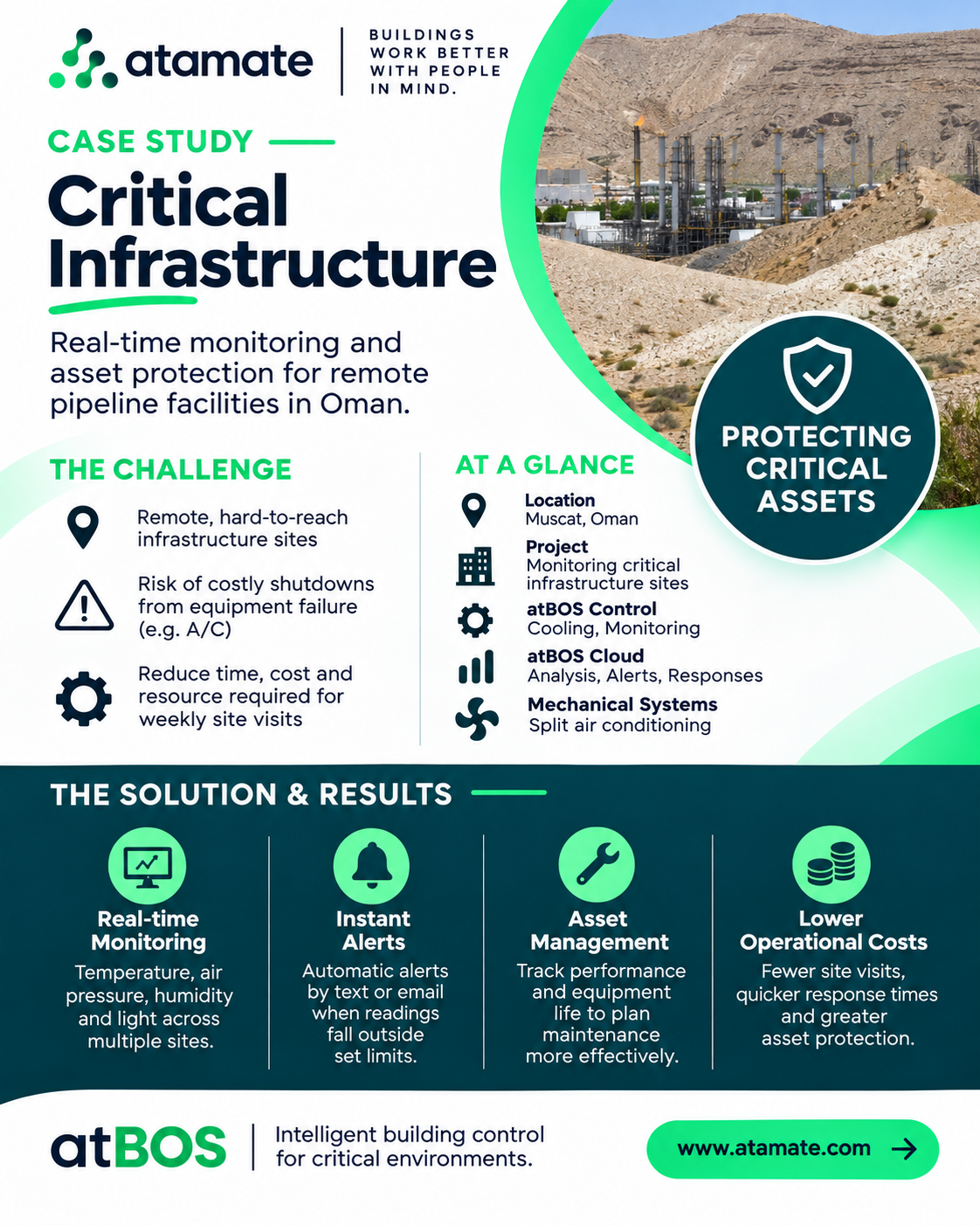
Every week, an engineer drives out to a remote building.
They check the air conditioning is running. They check the room isn't overheating. They check nothing has failed.
Most weeks, nothing has.
That's the reality for many facilities management teams responsible for critical infrastructure. It costs time and resources, and it still leaves a gap: whatever happens between visits goes unseen.
Remote building monitoring closes that gap. Here's how atBOS is doing it for a large multinational facilities management company working with major clients in Muscat, Oman.
The challenge: critical buildings, a long way from anywhere
The client manages a network of critical infrastructure buildings that form a vital part of a pipeline. Many are remote. All contain equipment that has to keep working.
The safety net was a weekly engineer visit to each site.
Time-consuming. Resource-intensive. And still a risk.
If the air conditioning fails in a building housing the computers that control a pumping room, that equipment can overheat. The pipeline could stop, and nobody would know until the next planned maintenance visit.
The client needed two things:
→ A real-time view of the systems and environment inside each building, without being there.
→ A more efficient way to manage maintenance of their assets.
The Atamate solution: atBOS for remote site monitoring
Atamate installed atBOS, the Atamate Building Operating System, as a trial across four very different building types:
a building controlling the main power intake to a large site
a storeroom holding magnetic tape records dating back to the 1930s
a large archive store and warehouse
the client's offices
Each has different priorities. The archive needs constant temperature and humidity to protect valuable documents. The power intake building relies on its air conditioning to protect the systems that power the whole site.
Five capabilities make it work.
1. Environmental monitoring sensors in every building Sensor units track temperature, air pressure, humidity and ambient light. In Atamate Analysis, the cloud data platform, managers can view each reading on its own or alongside the others, so anomalies stand out quickly.
2. Central control of set points Set points are managed centrally through a web-based interface. Site managers can keep the right temperatures across a whole site or a single building, without travelling to it.
3. Air conditioning power monitoring atBOS monitors the power drawn by air conditioning units. In buildings like the main intake, that's real-time asset protection, and it means site visits only happen when they're needed.
4. Three-level alerts by text or email If a device fails on site, an alert goes straight to site operatives so repairs happen faster. The client runs three alert levels based on how serious the issue is, and their own team can set up and edit every alert through the interface.
5. Occupancy-based cooling in the offices In one office, atBOS also controls the air conditioning based on occupancy. When a zone is empty, the air conditioning switches off. That stops out-of-hours energy use, a significant source of waste.
Built for secure, off-grid sites
There were two practical hurdles.
For security reasons, the client didn't want the system on their LAN. And many of these sites have no wired internet connection.
So the local Atamate Hub in each building uploads data to the Atamate cloud through client-supplied 4G routers. No LAN. No wired connection needed.
The result: go when there's a reason to
Atamate now gives the client proactive information that reduces operational expenditure.
Instead of finding problems on the next scheduled visit, the team is alerted to abnormal conditions and can investigate straight away. Less time goes on planned visits to sites where the plant is working exactly as it should.
Real-time visibility. Faster response. Fewer wasted journeys.
[ADD: any measured results, e.g. reduction in site visits, engineer hours saved, energy saved in the office, faults caught early]
And because the monitoring runs continuously, it can also be used to track equipment lifetimes, not just performance on the day.
What's next: vibration sensors and CAFM integration
The client plans to go further. Temperature and vibration sensors will be mounted on pumps and electric motors at pump stations, to monitor performance, show trends and raise alerts. That means more asset protection and fewer maintenance visits.
The atBOS data will also be fed into a CAFM (computer-aided facilities management) system to streamline maintenance management further.
Why remote building monitoring matters for facilities managers
You don't need a pipeline in Oman to recognise this problem.
Any FM team responsible for remote, unmanned or hard-to-reach buildings, such as plant rooms, archives or pump stations, faces the same trade-off. Visit often and burn resources. Visit less and risk not knowing.
Remote monitoring removes that trade-off. You can see what's happening inside every building, all the time, and send people out when there's a reason to.
FAQs
What is remote building monitoring? Remote building monitoring uses sensors and a cloud platform to track conditions inside a building in real time, such as temperature, humidity, air pressure, light and equipment power use. Managers see every site from one dashboard and get alerts when readings move outside acceptable limits, without visiting in person.
Can remote monitoring work without the client's network or wired internet? Yes. On this project the client didn't want the system on their LAN for security reasons, and many sites had no wired connection. The Atamate Hub in each building uploaded data to the Atamate cloud using client-supplied 4G routers instead.
How do building monitoring alerts work in atBOS? When a reading goes outside its acceptable window, for example a room getting too hot because an air conditioning unit has failed, atBOS sends an alert by text or email. Alerts can be tiered by severity, and the client's own team can set them up and edit them.
Can remote monitoring reduce maintenance visits? It can cut routine visits to sites where everything is working as it should. Teams are alerted to abnormal conditions and go out when there's a reason to, rather than on a fixed schedule. That saves engineer time and reduces operational costs.
Does atBOS only monitor, or can it control equipment too? Both. As well as monitoring, atBOS can control equipment. On this project it switches office air conditioning off when zones are unoccupied, cutting out-of-hours energy use.
Which of your buildings would you check first?
If you manage remote or critical sites and still rely on scheduled visits to know they're OK, it's worth a conversation.
Book a call with Joe Miles: https://atamate.com/joe