My flats beat Passivhaus and still only scraped an EPC C
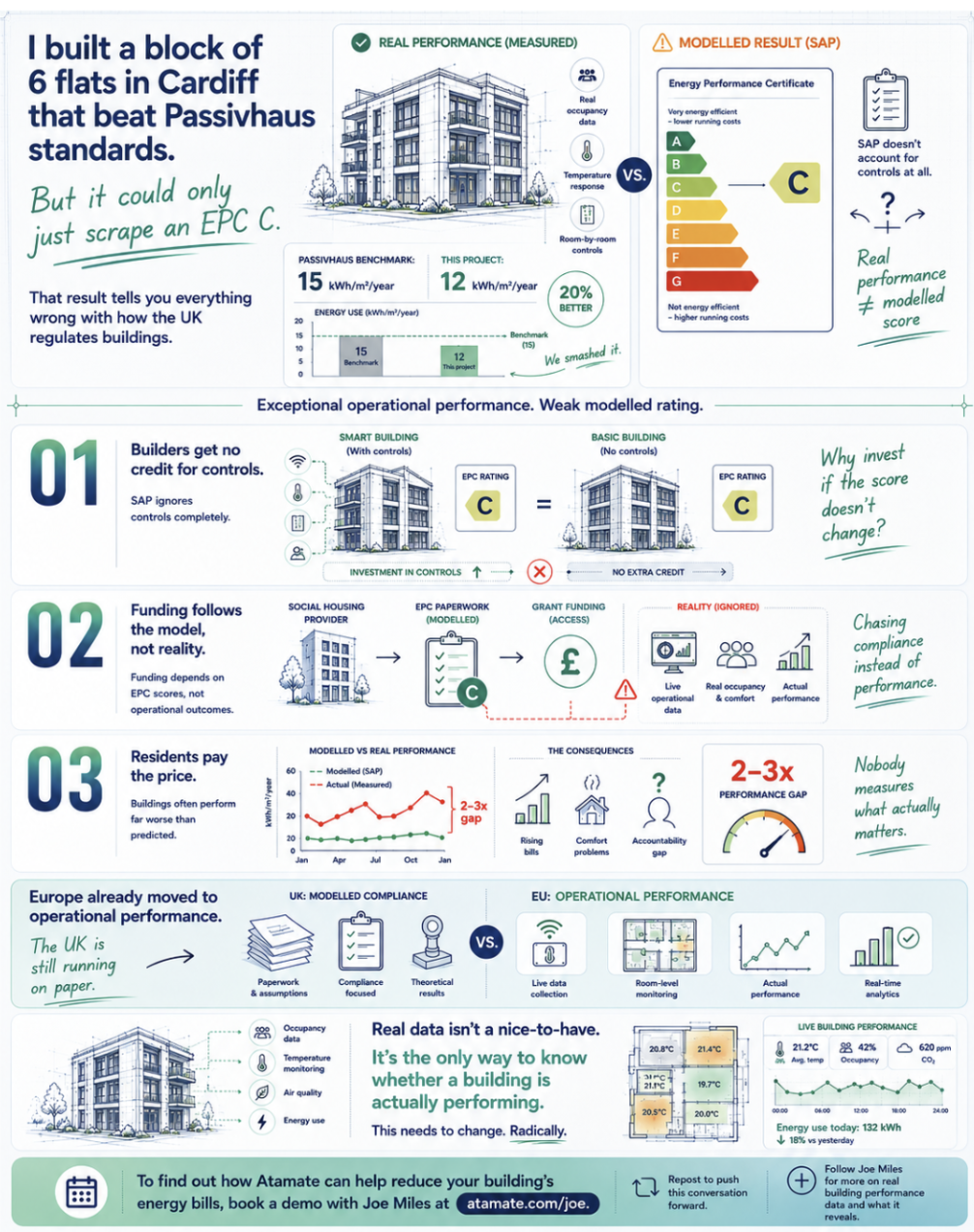
I built a block of 6 flats in Cardiff that beat Passivhaus standards.
It could only just scrape an EPC C.
That result tells you everything wrong with how the UK regulates buildings.
Here's what happened:
The building had simple mechanical systems. But it had really good controls. Real occupancy data. Real temperature response. Room by room.
We smashed it. The Passivhaus benchmark is 15 kilowatt hour per square metre per annum in the UK. We scored 12. This was on a building with cheaper fabric and simpler mechanical services.
But the SAP model didn't care. SAP doesn't account for controls at all. So despite the real-world results, the modelled score was mediocre.
The consequences of this are serious:
1/ Builders won't invest in controls they get no credit for. If a builder installs a properly controlled building and gets the same EPC as one with no controls, why would they bother? They won't.
2/ Social housing providers can only access grant funding by improving EPC scores. EPC scores are modelled numbers. They don't reflect what's actually happening in the building. So landlords chase modelled compliance instead of real performance.
3/ Residents pay the price. Buildings go up. Bills go up. The performance gap between what was modelled and what's real is routinely 2 to 3 times. Nobody is held accountable because nobody is measuring the right thing.
Europe has already moved away from this. The revised EU Energy Performance of Buildings Directive is built around actual operational performance, not theoretical compliance.
The UK is still running on paper.
This needs to change. Radically. Particularly for domestic buildings.
Real data isn't a nice-to-have. It's the only way to know whether a building is actually performing or just ticking boxes.
What's your experience of the gap between modelled and real performance?
To find out how Atamate can help you reduce your building's energy bills, book a demo with Joe Miles at atamate.com/joe.