The 4 pillars of smarter decarbonisation
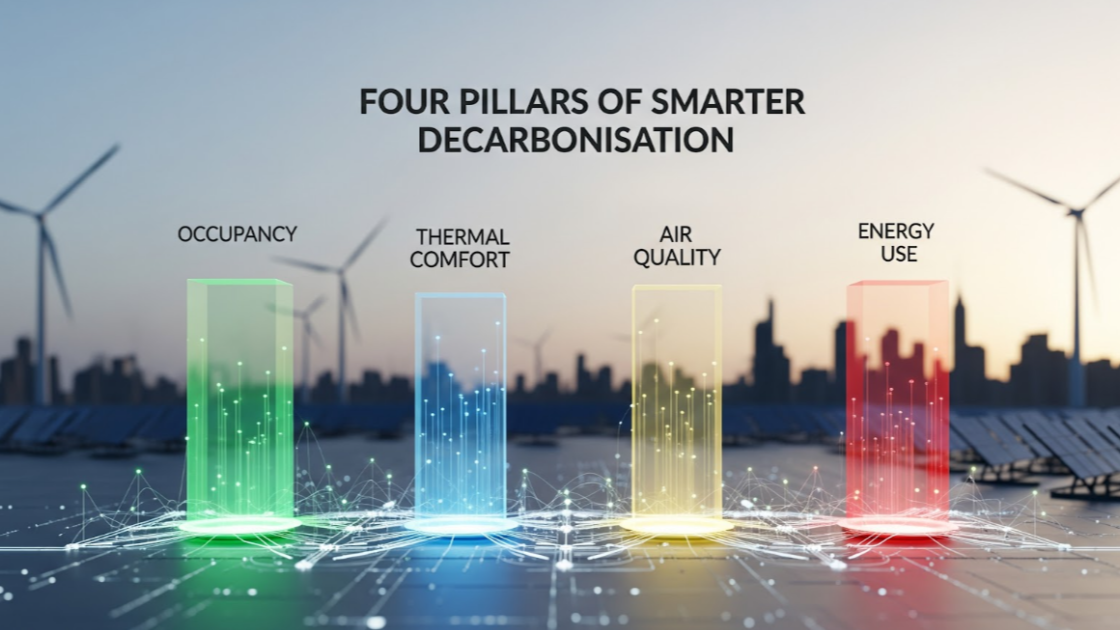
Decarbonising buildings is a huge challenge, but it doesn't have to be a shot in the dark. The Innovate UK-funded Alchemai project proves that a data-first approach can lead to smarter, more effective decarbonisation strategies. Instead of just adding new technology, it focuses on understanding what a building is actually doing. The project's secret weapon? The Four Pillars of Building Intelligence.
Think of these pillars as the vital signs of a building. Just as a doctor checks your temperature and heart rate, Alchemai's system uses smart sensors to monitor these four key areas.
Pillar 1: Occupancy - Who's Actually Here?
You can't optimise a building for people if you don't know when they're there. The Alchemai project uses sensors to see if a space is occupied, giving a clear picture of how a building is being used.
- Historic buildings like museums often show very low occupancy. Why heat an entire wing that's only used a few hours a week?
- Offices and community centers typically have more consistent use during core hours, while leisure centers are often busy from morning 'til night.
The takeaway: Occupancy data helps us align a building's services with its actual use, preventing wasted energy in empty rooms and that the most appropriate HVAC systems are being used..
Pillar 2: Thermal Comfort - Is it Too Hot or Too Cold?
Keeping people comfortable is key, but so is not wasting energy. Alchemai monitors temperatures to understand a building's thermal needs. A key finding is the difference between heating for people and heating for the building itself.
- Human comfort requires temperatures of around 20°C (68°F) or more.
- Building protection (to prevent dampness) only needs temperatures just above 12°C (54°F).
Data shows that some empty, older buildings are being heated far more than necessary for fabric protection. This points to a huge opportunity to save energy by adjusting heating schedules and improving insulation.
Pillar 3: Air Quality - Are We Breathing Easy?
Ventilation is crucial for health, but it's also a major energy factor. Air quality is monitored using sensors for things like carbon dioxide (CO₂) and relative humidity (RH).
- Low CO₂ levels often mean a space is empty or over-ventilated, wasting energy by constantly bringing in outside air that then needs to be heated or cooled.
- High CO₂ levels in places like offices or sports facilities can signal poor ventilation, which is a health concern and can also impact performance.
The takeaway: Understanding air quality helps us find the right balance between healthy air and efficient ventilation.
Pillar 4: Energy Use - Where Does the Power Go?
This is where the rubber meets the road. Alchemai's system provides a detailed breakdown of a building's energy consumption. This isn't just a total number; it's a granular view of exactly what is using energy and when.
- Sockets and lighting are often the biggest electrical drains in gas heated buildings.
- Leisure centers show a wide range of usage, from lighting to pool pumps and saunas.
- Surprisingly, some buildings with electrical heating showed very low energy use for heating, while others had heating as a major cost.
The takeaway: By seeing the details, we can target the biggest energy culprits, like vampire loads from office equipment left on overnight, and make precise, impactful changes.
Beyond the Pillars: A Holistic Strategy
The real power of the Alchemai project comes from using our data to sense check the recommendations of the Alchemai project. For example, a historic town hall might have thermal comfort issues due to a leaky building fabric, while a sports center's high energy use is tied to its constant high occupancy and specialized equipment.
By using data to understand a building's unique story, we can move past simple retrofits and create a personalised, data-driven decarbonisation strategy. It's about making buildings smarter, healthier, and more efficient for everyone.
💻 Want to know what your buildings are really doing? Book a call with Joe to discuss how room-level data could shape your decarbonisation strategy.