Children's Home Design: Safety Without the Institution Feel
A children's home has two jobs.
Keep young people safe.
And feel nothing like an institution.
Too often, the technology that does the first job works against the second. Keypads on every door. Plant rooms full of kit. Control panels only one person understands.
The Lighthouse Pedagogy Trust wanted something different. Here's how thoughtful children's home design, and the right controls, made it possible.
The challenge: safe, homely and affordable
The Lighthouse Pedagogy Trust is a charity that provides safe, nurturing homes for children in care.
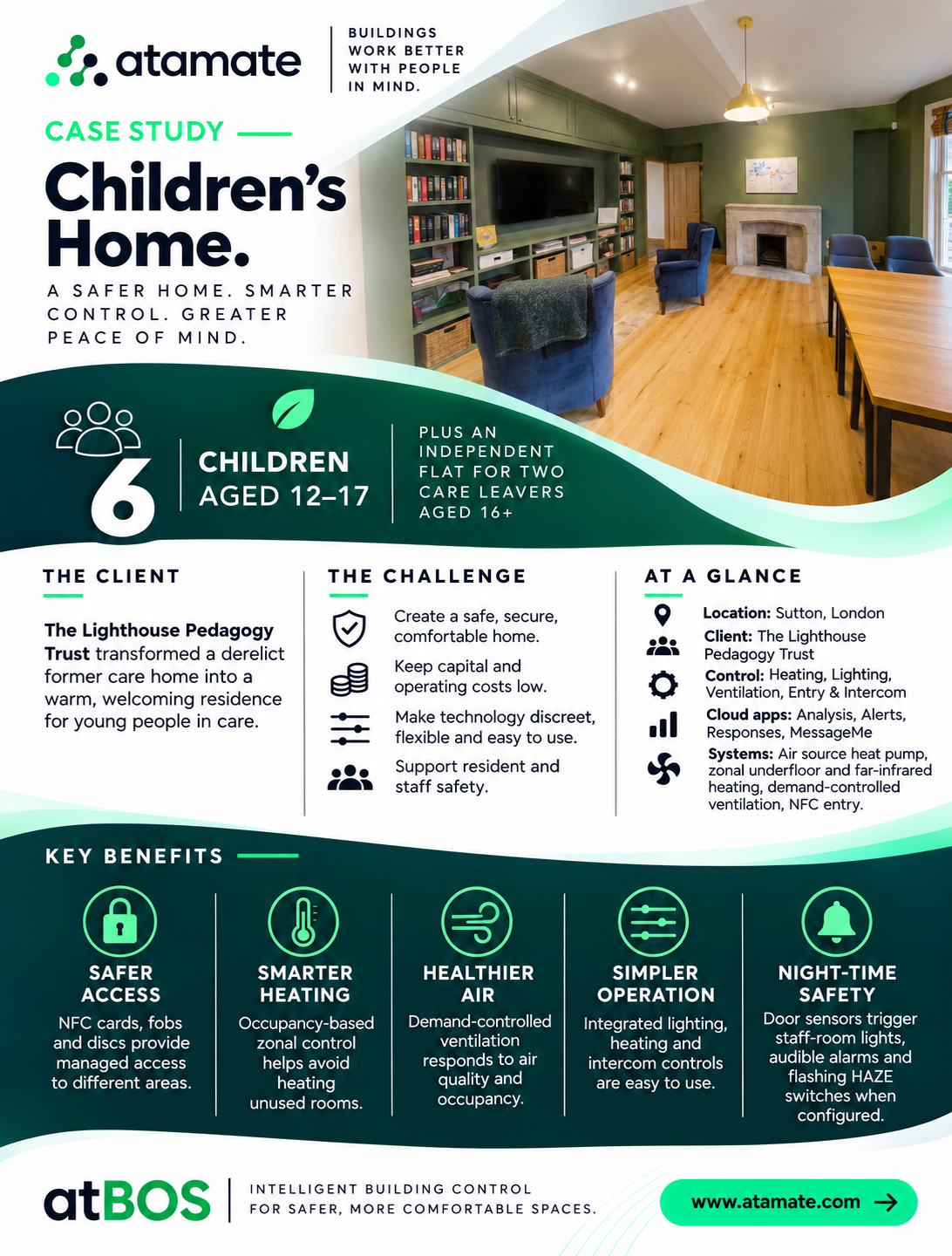
In Sutton, London, it took on a derelict former old people's home. The goal: a warm, light, welcoming home for six young people aged 12 to 17, plus an independent flat for two care leavers aged 16+.
The brief was demanding:
→ A secure, safe, comfortable environment for young people and their carers
→ Low capital build costs
→ Low ongoing operating costs
→ A finished home that looked as little like an institution as possible
→ Controls that were easy for every resident to use
→ Flexibility to adapt to the needs of whoever lives there
→ And above all, the ongoing safety of the residents
Any technology had to be low impact. Felt, not seen.
The Atamate solution
Atamate provided mechanical services design consultancy alongside atBOS, the Atamate Building Operating System.
atBOS runs metering, heating, lighting, ventilation and entry (including the intercom) from one system. Here's what that looks like in practice.
1. Simpler mechanical systems, lower costs
Complex buildings usually mean complex plant. atBOS let the client simplify the mechanical systems to reduce both capital and operating costs.
On the ground floor, zonal underfloor heating runs from an air source heat pump.
On the first and second floors, bedrooms and ensuites use electric far-infrared heaters. They respond fast, are easy to control and are driven by occupancy. That removed the need for a wet heating system upstairs and reduces energy use.
Because heating zones follow occupancy, rooms stay comfortable and no energy is spent heating areas nobody is using.
Managers set both the regular temperature and a boost temperature. Atamate HAZE switches on the upper floors control the lighting and act as a heating boost.
2. Demand controlled ventilation
Fresh air matters. So does not throwing heat away.
Demand controlled ventilation (DCV) uses indoor air quality data (CO2, VOCs, temperature and humidity) plus occupancy to decide when each room needs air. Rooms are only ventilated when air quality falls below a set point.
That cuts the energy used to ventilate and reduces heat loss. In eco builds, up to 50% of heat loss can come from ventilation, so not over-ventilating has a big impact on heating design and energy use.
The warm air doesn't go to waste either. The DCV extraction is connected to two exhaust air heat pumps, which use that exhaust heat to provide hot water throughout the building.
3. Lighting and access that are simple to use
All lighting is controlled by atBOS. Living areas use dimmable DMX lighting; ensuites and other areas use non-dimmable lighting. It's controlled with switches, encoders and HAZE switches.
At the front door, the intercom calls staff mobiles and tablets. Access is simple and controlled.
4. Keyless entry built around each resident
Every door, internal and external, has an NFC (near field communication) pad. Residents use NFC cards, key fobs or discs to get into rooms. No physical keys.
atBOS Entry gives different people access to different areas:
→ Staff have access to all areas → Younger residents can reach their own room and some common areas → Older residents can reach their own room and different common areas
A lost tag is simple to replace. Changing a tag's access rights (which doors it opens, and when it starts and expires) is just as easy.
Records show when and how often each door is opened, which helps track attempts at unauthorised entry. At the client's request, this access data is kept for 30 days. All NFC readers have anti-tamper measures.
5. Night-time safety without waking night staff
This is the big one.
Every resident's room has a door sensor. When the door alert is enabled through atBOS Responses and a door is triggered, three things happen at once:
→ An audible alarm sounds → The lights in the staff sleep-in room come on → The HAZE switches flash red
That means a fast response, while staff have the peace of mind to sleep. Simple on/off switches disable the Response and silence the alarm.
The outcome: the client avoided the need for night staff who have to stay awake all night.
The result?
A safe, secure and healthy home for vulnerable young people.
The key was reducing the complexity of the mechanical systems a sustainable residence needs, keeping the building simple to run, and adding the bespoke features that improve safety for residents and managers.
Less kit. Fewer keys. More sleep for staff.
That's what happens when building controls are designed around the people who live there.
Why this matters for children's home design
If you run, commission or develop children's homes, supported living or care leaver accommodation, the pressures will sound familiar. Tight budgets. High safety standards. And a duty to make a building feel like home.
This project shows you don't have to trade one off against another.
One system handles heating, ventilation, lighting, entry and night-time alerts. Residents get simple switches and a tag instead of a bunch of keys. Managers get control and records. And the technology stays out of sight.
Frequently asked questions
What should good children's home design include?
A good children's home needs to be safe, secure and comfortable while feeling homely rather than institutional. In this Sutton home, that meant keyless NFC entry, occupancy-based heating, demand controlled ventilation, simple switches residents can use, and alerts that support staff at night, all run from one system.
Can a children's home run without waking night staff?
In this project, atBOS made it possible. Door sensors on residents' rooms link to atBOS Responses: an alarm sounds, the sleep-in room lights come on and switches flash red. That fast response meant the client could avoid needing staff awake all night. Any staffing model must still meet your regulatory and safeguarding requirements.
How does keyless entry work in a children's home?
Every internal and external door has an NFC pad. Residents use a card, fob or disc, and each tag only opens the doors it's set up for. Staff can access all areas. Lost tags are simple to replace, access logs help track unauthorised entry attempts and readers have anti-tamper measures.
What is demand controlled ventilation?
Demand controlled ventilation only ventilates a room when it needs it, based on indoor air quality (CO2, VOCs, temperature and humidity) and occupancy. That avoids over-ventilating, which matters because up to 50% of heat loss in eco builds can be due to ventilation. Here, exhaust heat also provides hot water.
Can atBOS be installed in an existing building?
Yes. This home was created from a derelict former old people's home. atBOS is wireless and retrofittable, so it works with the buildings you already have, with no rip-and-replace.
So, how much of your building's safety still depends on keys and people staying awake?
Book a call with Joe Miles to see how atBOS could work in your building: https://atamate.com/joe