The performance gap: why building models get it wrong
Your building is using 3 times more energy than the design promised.
And nobody seems to care that the models are completely wrong.
Every day, building owners pay energy bills that are routinely 2 to 3 times higher than what SAP and SBEM models predicted.
We call this the "Performance Gap."
The chasm between design promise and operational reality.
Models don't live in buildings. People do.
Here's what's happening while the UK clings to outdated compliance models:
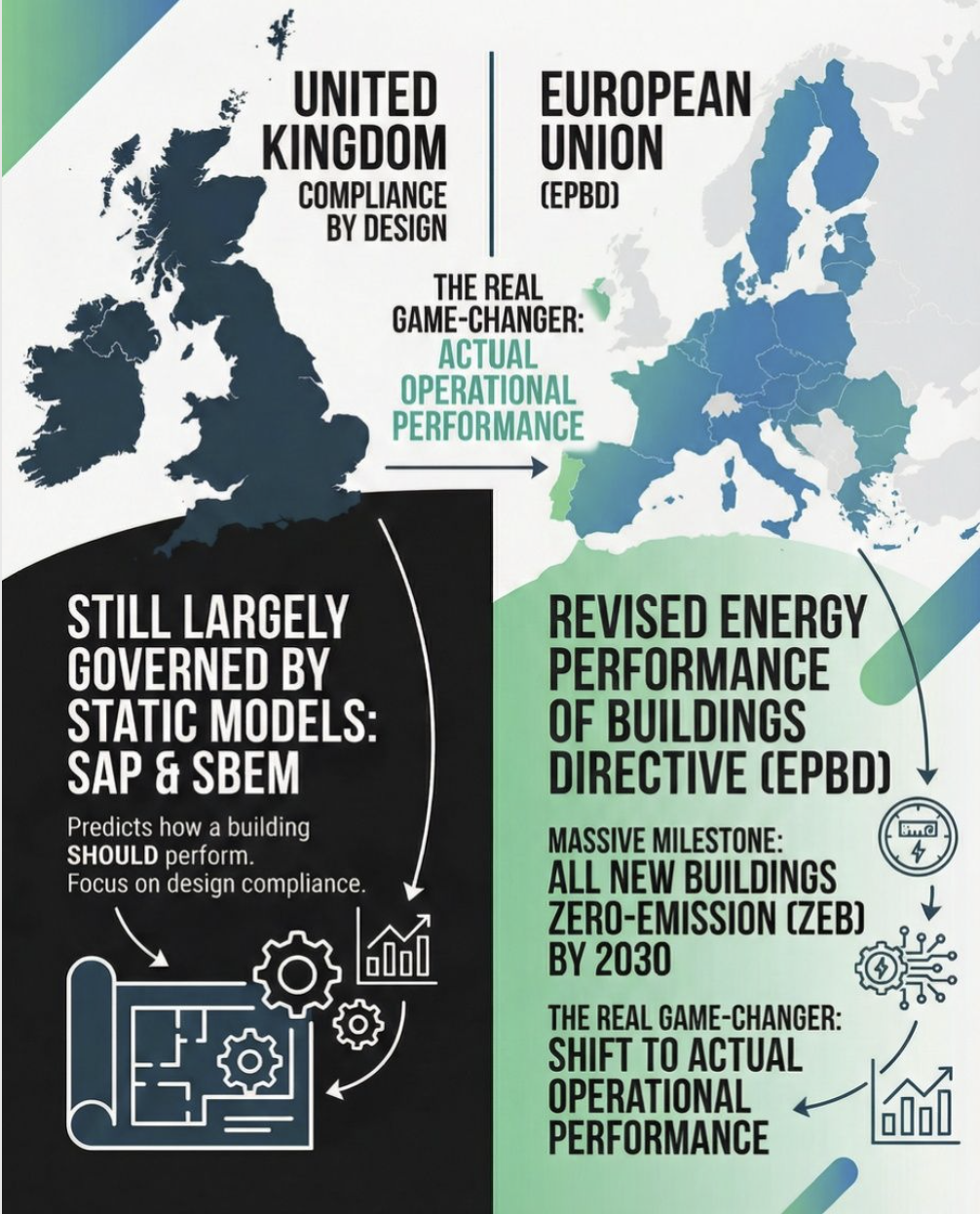
Europe is rewriting the rules. The EU's revised Energy Performance of Buildings Directive (EPBD) demands that by 2030, all new buildings must be Zero-Emission Buildings.
Based on actual operational performance. Not theoretical compliance.
Meanwhile, the UK remains stuck in "compliance by design" mode.
Our models assume perfect conditions:
→ Windows always shut
→ Heating systems used exactly as designed
→ People behaving like predictable machines
The reality? Buildings don't operate in laboratory conditions.
The EPBD prioritizes what actually matters: real energy use and indoor environmental quality. This performance-driven approach requires high-granularity data across entire buildings.
Here's what high-quality building data reveals:
Real-time occupancy control delivers 30% energy reductions by responding to actual building use:
→ Don't heat the office on Friday when everyone's working from home
→ Interlock windows with HVAC systems
→ Let buildings adapt to real occupancy patterns
Precision retrofits show different buildings need completely different solutions. A hospital ward operating 24/7 has nothing in common with a primary school classroom.
Electrical heating systems are less forgiving than traditional boilers. Over-specify or under-manage, and costs skyrocket.
The choice is clear: performance-based design that works in the real world, or compliance-based models that work on paper.
Europe is choosing performance. The question is: what will YOU choose for your buildings? Want to talk it through? Book a call with Joe Miles atamate.com/joe