Your building has controls. But is it actually controlled?
Your building has controls. But is it actually controlled?
There's a big difference. One means equipment is installed. The other means your building responds to what's happening inside it, in real time.
Here's how to tell the difference.
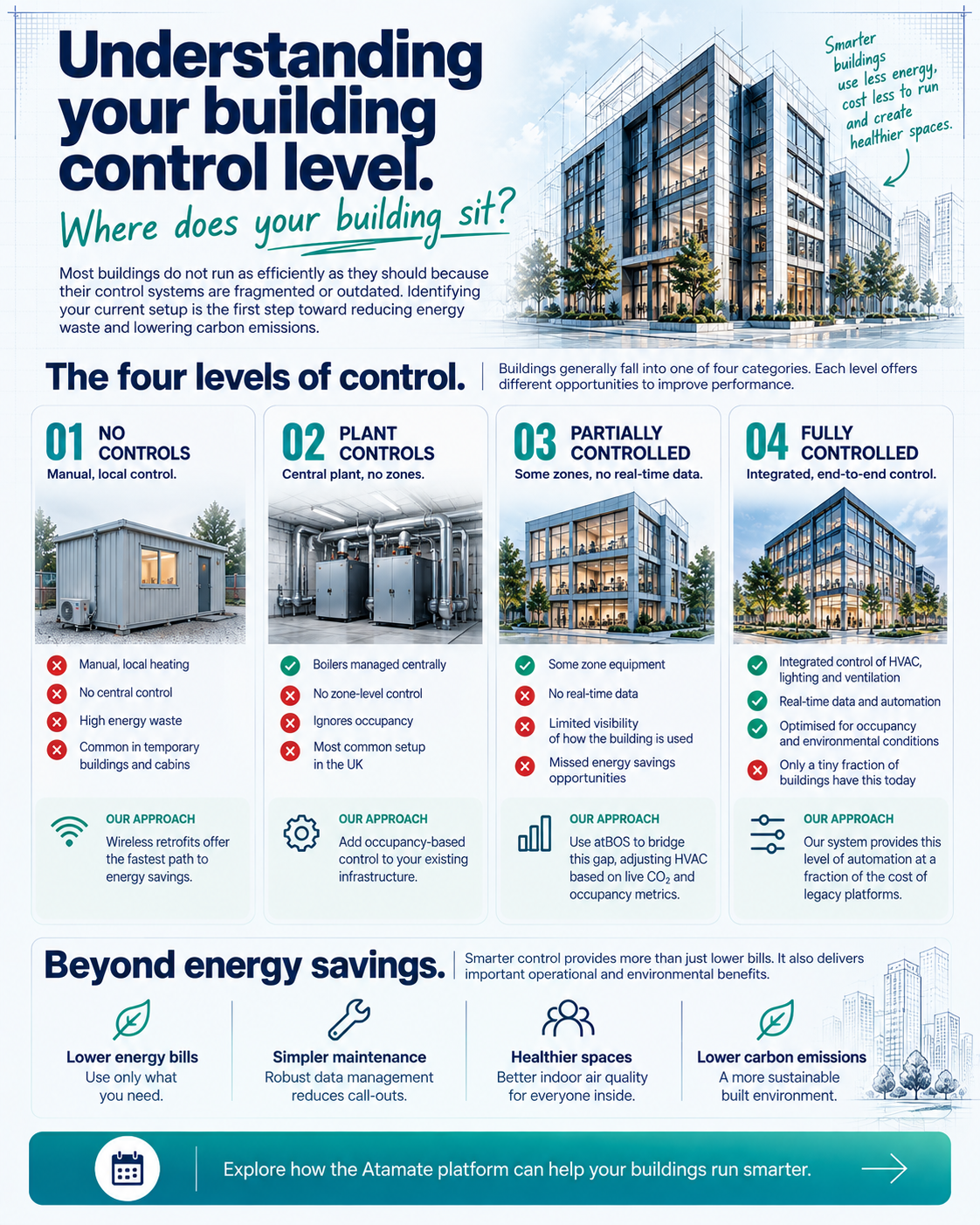
So here's the Building Control Sophistication Index. A simple four-level framework to identify where any building sits today - and what's possible.
Level 1 - No Controls
No centralised mechanical systems. Heating is handled by individual electric room units, switched on manually or through basic local timers.
Think temporary on-site cabins, some student accommodation.
Atamate's wireless controls can be retrofitted quickly, with payback driven by immediate reductions in energy cost. No major infrastructure required.
Level 2 - Plant Controls
This is where the majority of UK buildings sit.
Central control exists for the main mechanical equipment - boilers, pumps - but there's no zone-level management across the building. The plant runs. The rest is guesswork.
Existing plant controls can stay in place. Layering in zone management cuts energy use based on occupancy and interlocking. The data collected also becomes the foundation for moving away from gas and oil toward electric heating and cooling.
Level 3 - Partially Controlled
Central plant plus basic zone equipment, such as fan coil units in an office block. On the surface, this looks like a controlled building. It isn't. Not really.
Without real-time operational data - live occupancy, CO2 levels - the system is reacting to a clock, not the building. It can't respond to what's actually happening inside.
atBOS bridges that gap. High-resolution monitoring of CO2, occupancy and environmental conditions feeds directly into HVAC control, adjusting the building to match actual demand rather than a fixed schedule.
Level 4 - Fully Controlled
End-to-end integration across plant and zone devices. Continuous automated optimisation. Full operational visibility.
Less than 5% of real estate is here.
atBOS delivers this at a fraction of the cost of legacy control systems. The energy savings are significant. And the clarity you gain over how your building is actually performing - day to day, hour to hour - changes how you manage it.
Energy savings and carbon reduction get most of the attention. Rightly so. But the benefits reach further than that.
Better data means simpler maintenance. Fewer reactive call-outs. Less admin burden on facilities teams. And a healthier indoor environment for the people inside - better air quality, more consistent temperatures, fewer of the issues that no one flags until they become impossible to ignore.
So - which level is your building at?
If you're not sure, that's worth paying attention to. Book a call with our team and we’ll help you figure it out: https://atamate.com/joe